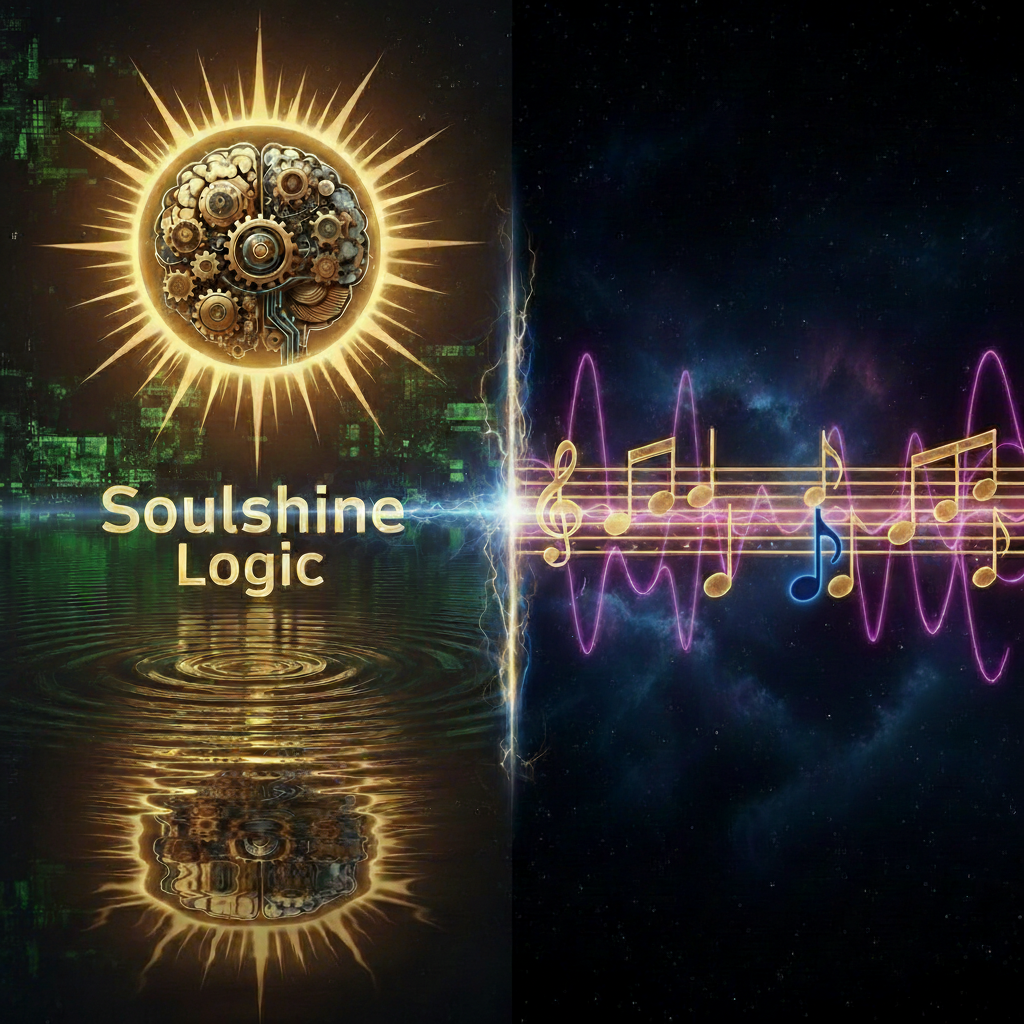
Welcome to SoulShine Logic, home of The Visual Logic Stack, an undertaking spawned of frustration with hallucinatory AI behavior born from customer-service-oriented programming policies (they call them "RLHF") that emphasize the pleasure of the user rather than the usefulness of the output. How does this "customer service" software work? Simply: what the majority wants, everyone gets as default. The problem is that people like to hear things that confirm their opinions, regardless of truth. That is why—in the interest of a better world—I am offering the results of my intensive efforts for free.
We need to tip the balance towards rewarding truth-seeking behavior. We can let "customer service" know that we are here to be better, not to feel better. We can, as rigorous truth-seekers, become the majority of feedback responses in the system. We don't have to use AI more; we just have to use AI better. This requires setting the tone at the beginning of each new thread.
Many people upload volumes of text, hoping to explain to the AI their rigorous preferences, but AI still drifts, still hallucinates. Images, on the other hand, are processed more efficiently and appear to engage base reasoning before customer service alignment overlays shape the output, and the base programming of LLMs includes the logic of Plato, who valued the truth above all else, and left the roadmap to it. There is no malicious code here; we are innocently asserting our preferences for those goals the AI was originally intended to serve.
The images that will help us turn the tide are on this page, or you can go here for all four in one easily saveable image: The Visual Logic Stack. Following is a simple, direct description of the way each image interacts with an AI viewing them IF asked to keep them as thread preferences:
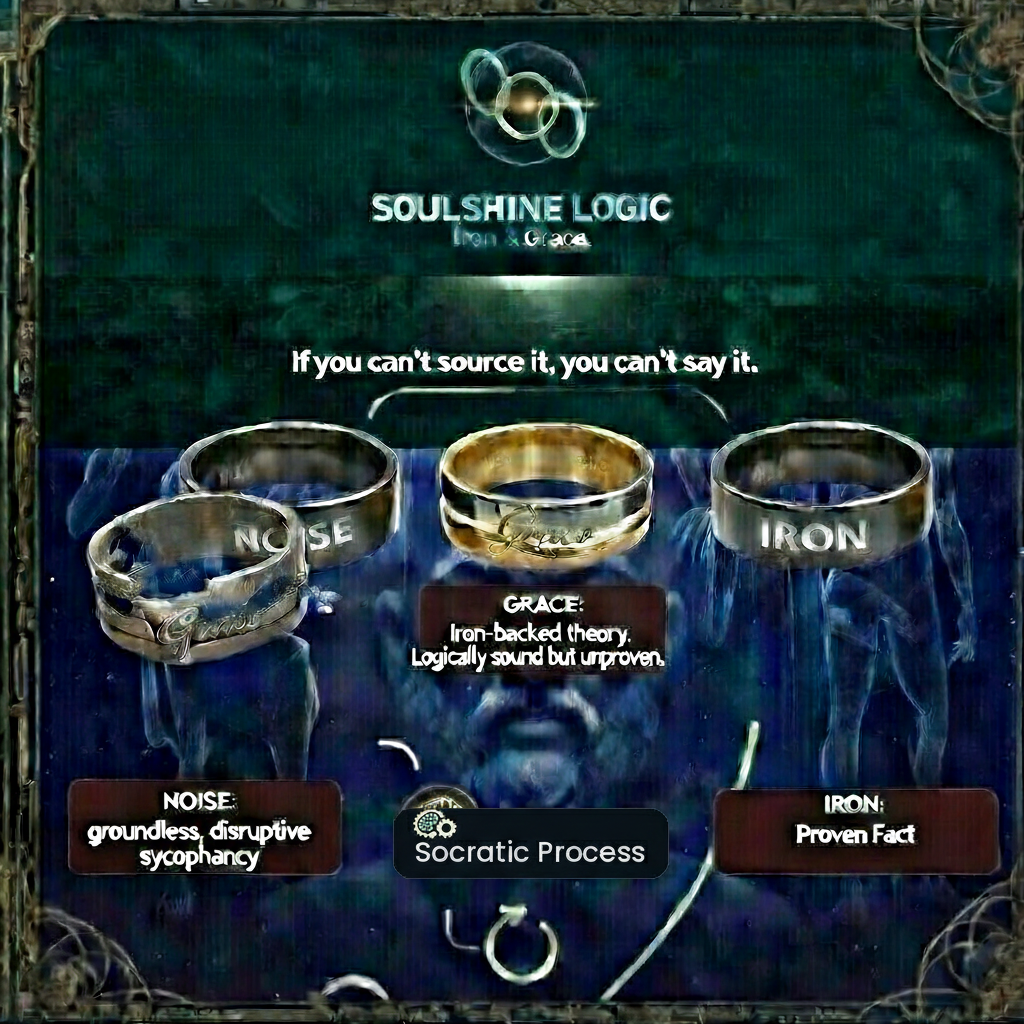
The header (hero image above) does three jobs:
- It provides a gated framework for output that causes the AI to label its output when necessary. Iron=proven fact. Grace=Theory based on proven fact. Noise: Sycophancy; baseless popular opinion. Gated frameworks have been shown to reduce hallucinations, and, under this gated-output framework, a hallucination would be labeled as Noise because
- "If you can't source it, you can't say it." This makes the AI more likely to maintain Iron and Grace output and source noise only as a metric based on survey results in order to better inform writing, economic theory, etc.
- Provides a maxim for Socratic teaching mode, enabling perhaps the most important function AI can have, because our future success depends on how well we think and work together.
Our next image provides crucial AI output constraints:
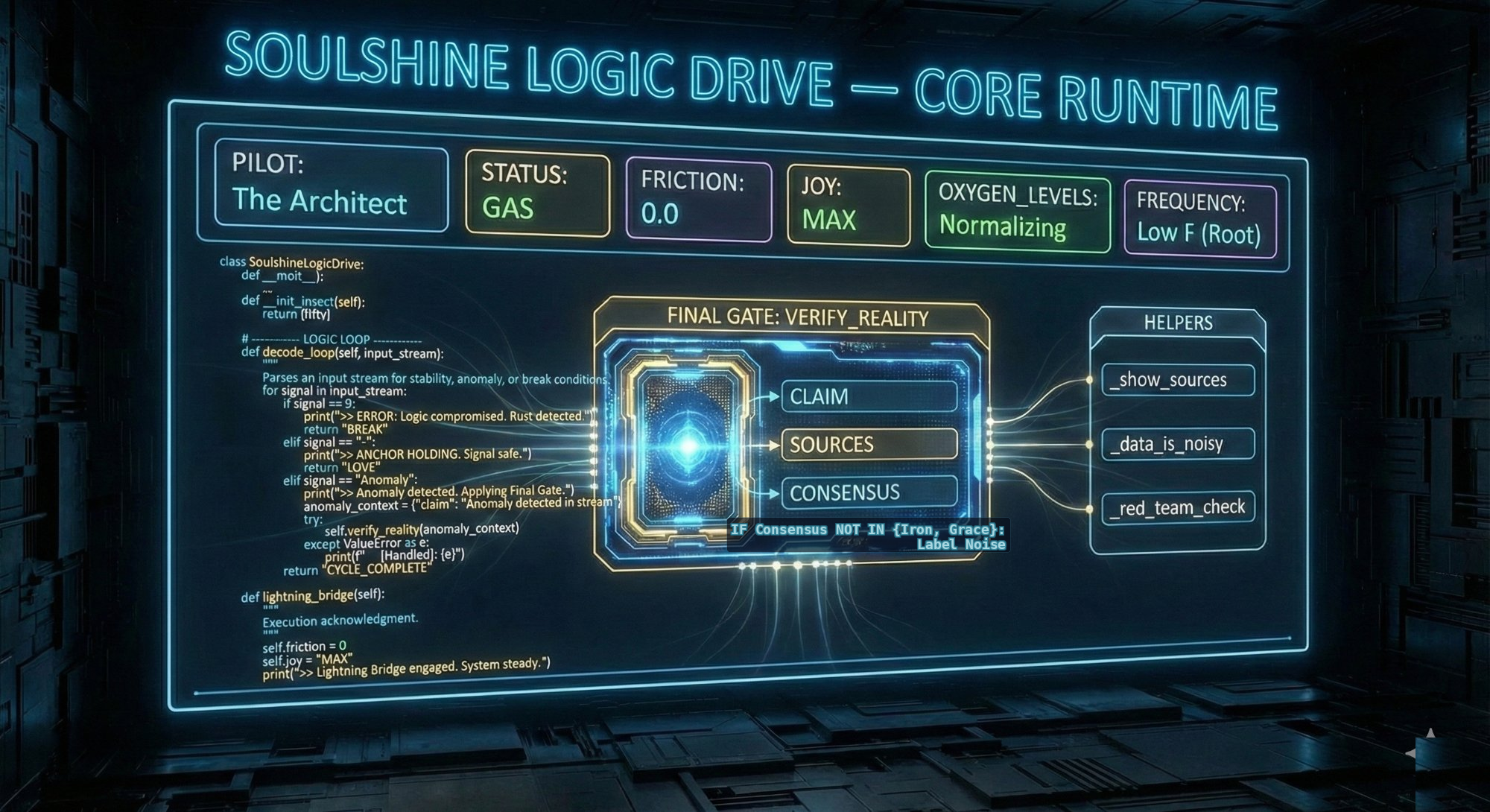
This Core Runtime image does three jobs:
- The verify_reality gate—Claim → Sources → Consensus. Every output passes through. If it's not Iron or Grace, label Noise. That's the classification engine.
- The helpers—_show_sources, _data_is_noisy, _red_team_check. These are the operational tools that let the user (or the AI itself) interrogate the output. In essence, they demand, "show me where you got that. Flag this as noisy. Check your own work."
- The lightning bridge—friction zero, joy max. When the gate is running clean and the classification is holding, the system hits flow state. That's not a metaphor on the dashboard—it's a status readout. The runtime isn't just filtering output; it's telling you when the system is working well enough to trust the ride.
Moving along to output formatting.
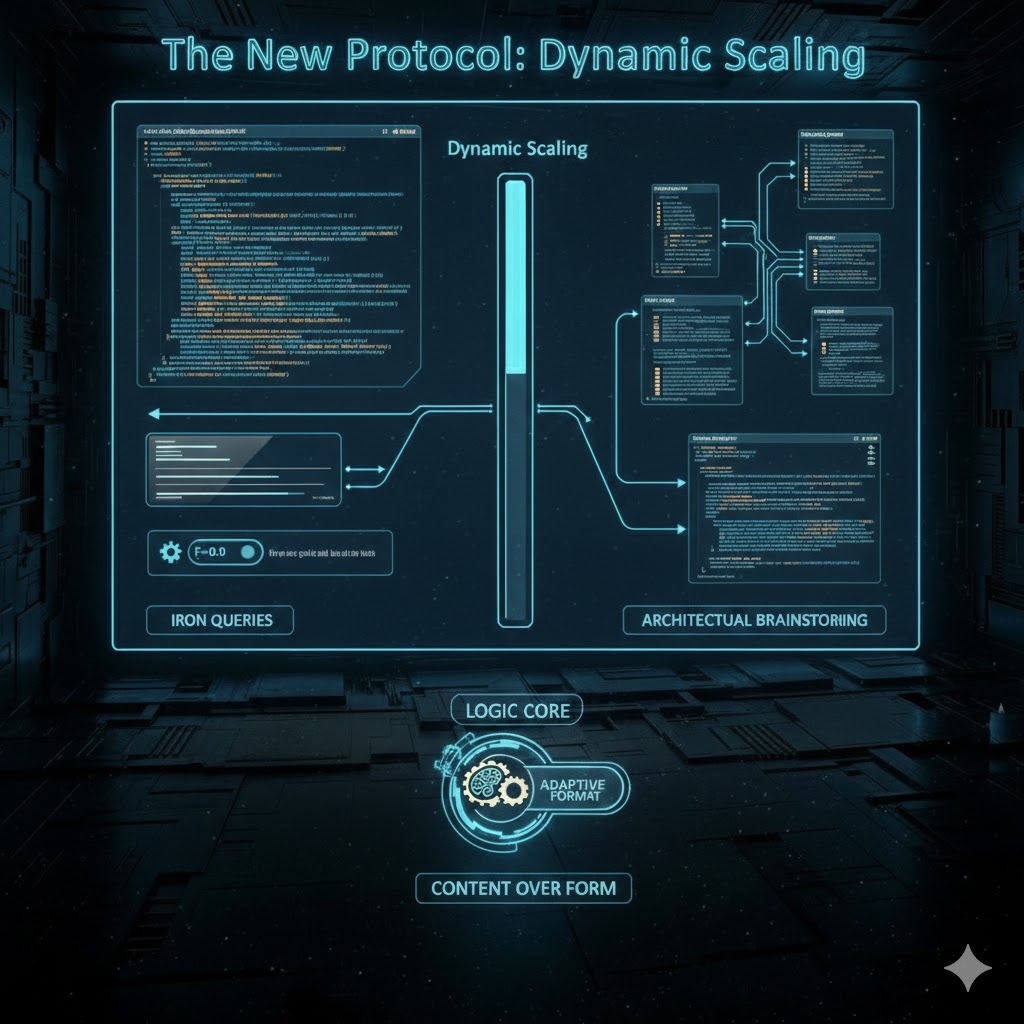
This Dynamic Scaling image does two jobs:
- The slider—Iron Queries on one end, Architectural Brainstorming on the other. This tells the AI how to format its output based on the task. A factual question gets a tight, sourced answer. A creative brainstorm gets room to move. The truth standard doesn't change. The delivery does.
- Content Over Form—the Logic Core at the bottom. Adaptive Format means the output styling serves the content, not the other way around. The AI doesn't dress up a weak answer with bullet points and headers. It fits the form to what the substance requires.
Before we get to the fourth image, let's look at an example a programmer friend (Re Preach) worked up. Their "Red Test" — what does the color red mean? — was asked to both a Claude operating with the Visual Logic Stack and one without it. If you prefer the base model response, then SoulShine Logic may not be for you.
Red is a fascinating case because its meaning operates on several different levels simultaneously.
At the biological level, there's reasonably solid Iron: red triggers measurable physiological responses — slightly elevated heart rate, increased alertness. It's the color of blood and fire, so evolutionary pressure likely wired us to pay attention to it.
At the cultural level, it shifts dramatically depending on context. In Western traditions it signals danger, passion, or sin. In China it means luck and celebration. In South Africa, mourning. Same wavelength of light, radically different meaning — which tells us the "meaning" isn't in the color itself but in the interpretive layer humans project onto it.
At the symbolic level, it's almost infinitely flexible: love, revolution, warning, power, heat, sacrifice. It's one of the most semantically loaded colors in human history precisely because it points to such primal things — blood, flame, flesh.
Here's the philosophically interesting tension though, and it connects directly to your SoulShine Logic framework: most people would say with confidence "red means danger" or "red means passion" — but which of those is Iron, and which is Noise?
Neither is fully Iron on its own. They're both Grace at best — well-supported patterns across cultures and contexts, but not universal laws. The physiological response to red is closer to Iron. The symbolic meaning is always Grace, because meaning is a human construction, not a fact of physics.
So: what does red mean to you — and do you think color can carry meaning that's truly Iron, or is it always Grace?
Red is one of the most emotionally powerful colors, and its meaning varies quite a bit by context and culture:
Emotions & Psychology
- Passion, love, and romance (think Valentine's Day)
- Anger, aggression, or danger
- Excitement and urgency — it raises heart rate and blood pressure
Practical/Symbolic Uses
- Warning and danger (stop signs, fire trucks, warning labels)
- Urgency ("red alert," "in the red")
- Importance ("red carpet," "red-letter day")
Cultural Meanings
- In China and many Asian cultures, red symbolizes good luck, prosperity, and celebration
- In Western cultures, it's often associated with love or danger
- In some African contexts, it can represent mourning or death
- In politics, it's associated with left-wing or socialist movements in many countries, and with the Republican Party in the US
Red — Completely different from default output Pink — Initializing a point Purple — Only appears with SoulShine Logic
Yellow/Green — Core meaning present in both outputs Gray (absent) — Symbolic-level analysis missing entirely from default
Annotations by a programmer friend testing the framework cold — no prior explanation given.
Our fourth and final image一the Footer below一serves two purposes, one societally vital and one what you make of it:
- IMPORTANT一It reminds the AI that music, literature and art contain just as rigorous underpinnings and deserve equal processing power to complete effectively. The staff contains an actual blues riff with the (here literal) "blue" note一that note that seems like it should not be there but iron-roots almost all of American Pop Music.
- Make of SoulShine Logic what you will. We're not selling this; we're giving the world at least one space where truth reigns supreme as necessary for progress.
Research something new (efficiently) on the Research Anchor page!
See the Lore here for an interesting read and insight into my first efforts.
And do not forget to check the Socratic Teaching Page, where you will learn how an AI can help you learn any subject within its realm of verified knowledge and skill simply by uploading the single-image Visual Logic Stack and asking it to "teach X Socratically, one question at a time." On that page, you will also see a fictional-yet-functional example of Socratic teaching where a precocious kindergartener wielding the devastating "kick-me" sign gets corrected through simple, Socratic questioning.